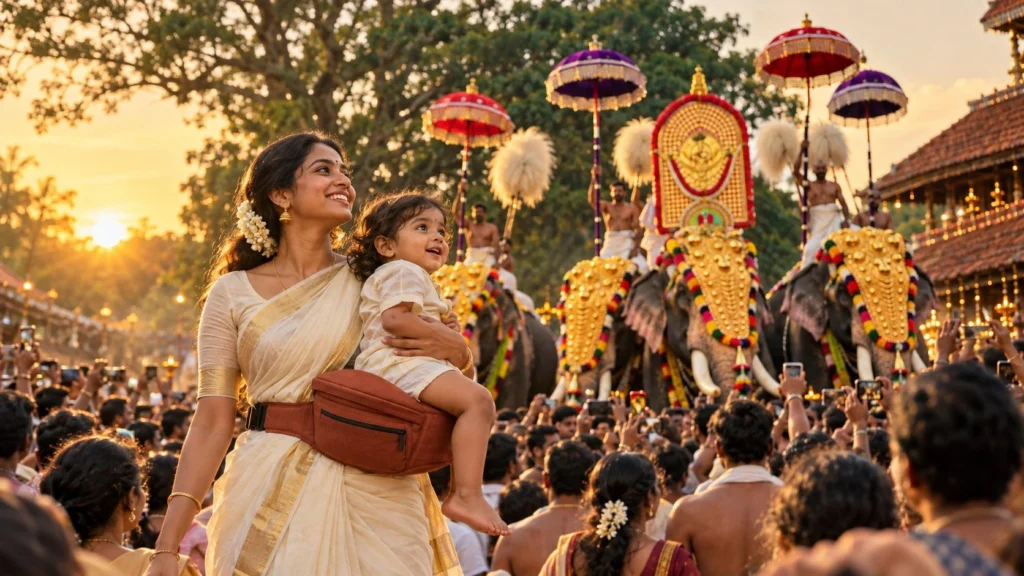
There seemed to be nowhere to sit at Thrissur Pooram. For Anjana, the most unforgettable sight was the little face beside her own.
The festival is real. Anjana, Ammu and their family are imagined. This is a fictional story inspired by family life in Kerala; images are illustrative and include AI-generated scenes. The Nest Hip Seat is a design in development.
One word. Both arms.
Before she knew the word for elephant, Ammu knew how to ask for her mother.
She would stop in the middle of whatever she was doing, look up and stretch out both arms. Sometimes she said it. Sometimes she didn’t need to.
Up.
At eighteen months, the world was full of things Ammu wanted to reach. The kitchen counter. A window latch. The flowers in her grandmother’s hair. And, that week, a festival her family had been talking about for days.
Anjana had grown up with Pooram stories. She remembered the parasols as enormous flowers opening above the crowd. She remembered holding someone’s hand so tightly that her fingers hurt. Now she was the one packing the bag.
Water. A cotton cap. A change of clothes. A meeting point agreed with Hari. A plan to leave early if Ammu had had enough.
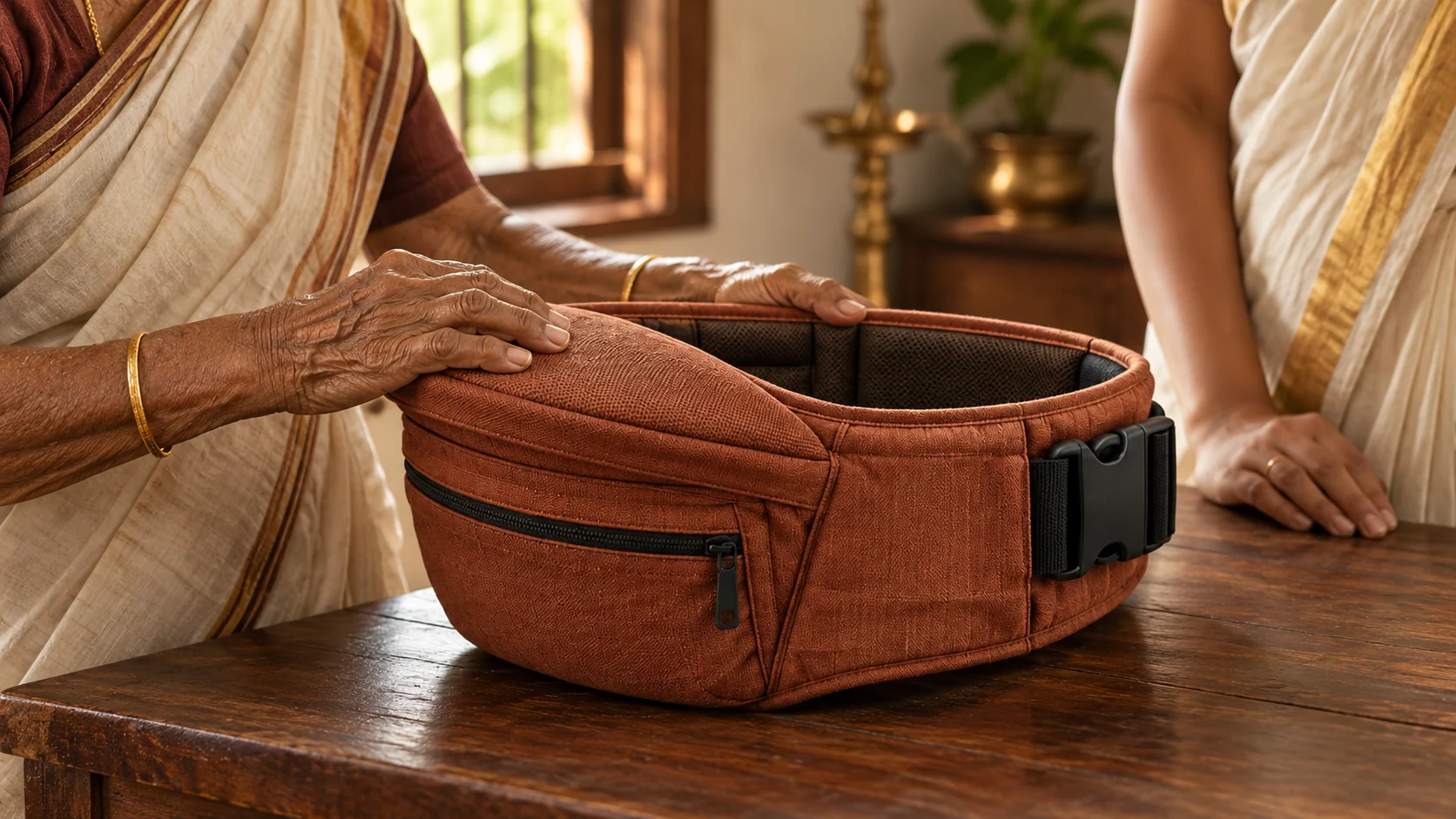
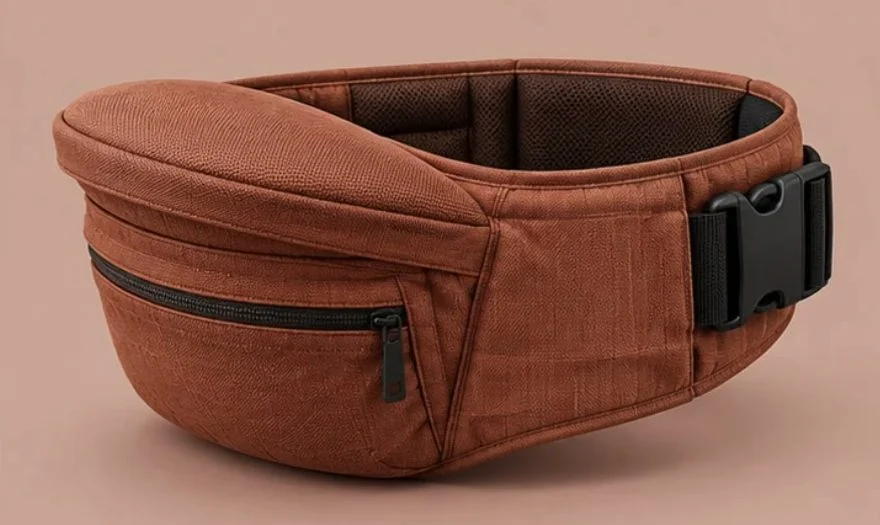
The terracotta hip seat lay beside the bag. In this imagined first outing with Nest, Anjana fastened it around her waist, settled Ammu onto the seat and kept a supporting arm around her back.
Ammamma watched from the doorway.
“She has legs, you know,” she said.
As if to settle the argument, Ammu lifted both arms again.
Small suns.
Small fingers.
A few evenings earlier, they had visited the chamayam, where the elephant ornaments were on display. Anjana wanted a shorter outing before attempting a little of the festival itself.
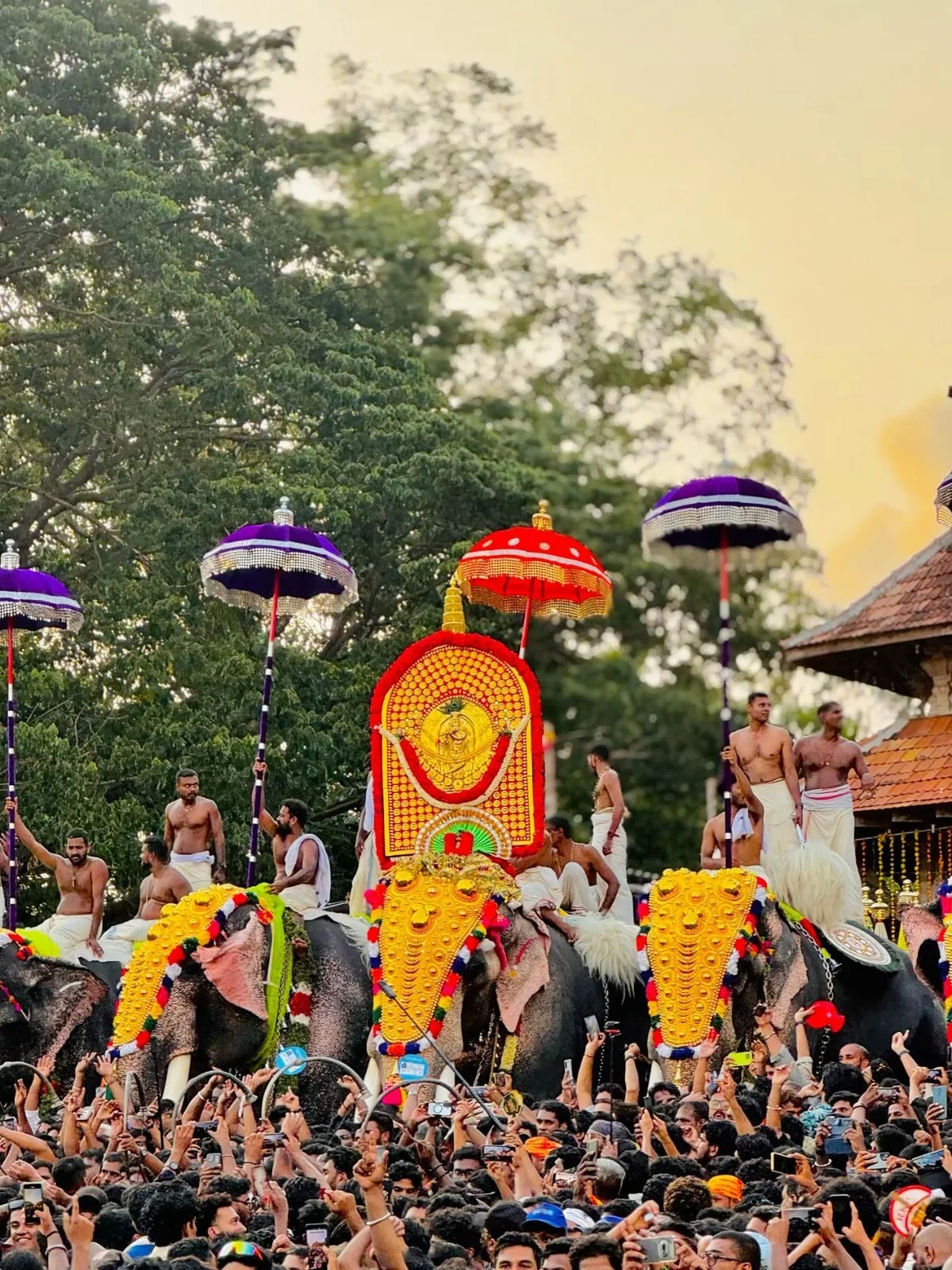
There were golden nettipattam, the forehead ornaments Ammu would soon see from a distance. Under the exhibition lights, they looked like small suns.
Ammu reached towards the gold, opening and closing her fingers. Anjana smiled and kept her back from the display.
They paused when they needed to. Adjusted the fit. Went home before the queue became too much.
It was a small rehearsal. Anjana was learning to make room for a child’s pace inside a grown-up plan.
The drums, from a distance.
By afternoon, Thrissur seemed to move in one direction. White mundus. Kasavu borders. Umbrellas lifted above heads. The city carried its festival in flashes of colour.
Anjana had imagined seeing everything. With Ammu beside her, she began choosing instead.
They stayed away from the densest crowd and the loudest music. Ammu wore child hearing-protection earmuffs; when the sound and bustle grew too much, they moved on. Hari carried the bag and found somewhere quieter for water and shade.
Under a shop awning, Ammamma took out a small cloth and wiped a damp curl from Ammu’s forehead.
“Enough?” Anjana asked.
Ammu pointed towards a flash of purple beyond the rooftops.
Not quite.
She had come to show her daughter the festival.
She found herself watching her daughter instead.
The view she almost missed.
When the kudamattam began, the parasols rose and changed above the decorated elephants: crimson, purple, gold. From their viewing spot, well back from the animals and behind the barriers, the movement looked almost like a conversation with the sky.
Ammu went still.
Then both arms flew up.
Not towards Anjana this time. Towards the colour.
Around them, phones lifted. Anjana’s stayed in her bag. She watched the surprise travel across her daughter’s face—the raised eyebrows, the open mouth, the sudden laugh.
For a moment, she remembered being small herself, seeing only pieces of a festival through the shoulders of adults. Someone had lifted her then, too.
She couldn’t remember whose arms they were. Only that, suddenly, she could see.
A smaller celebration.
They did not stay for everything.
By evening, Ammu’s pointing had slowed. Her cheek found Anjana’s shoulder. The family chose home over another stretch of crowd, and left the late-night fireworks out of their plans.
At home, someone pulled out a chair. Anjana sat, loosened the belt and let Hari take Ammu while she drank her tea.
Through the window came the ordinary sounds of the house: a tap running, cups touching saucers, Ammamma asking whether anyone had eaten.
Anjana had photographs of the festival from other years. This year, the moment she kept returning to was a little pair of hands reaching into the sky.
What Ammamma remembered.
Over morning tea, Ammamma picked up the seat.
She pressed her thumb along the fabric. Found the zip. Opened it. Closed it. For a while, she said nothing.
“When he was this age,” she said to Anjana, nodding towards Hari, “I used to fold a cloth here.” She touched her waist. “Just to help while I held him.”
Hari looked up from his cup. He had never heard that story.
“Did your mother show you?” Anjana asked.
Ammamma thought for a moment.
“Maybe. Or I watched her do it.”
She turned the seat over once more, then placed it beside Anjana’s tea.
“So,” she said, “did she see the umbrellas?”
Anjana took out her phone at last. Not a photograph of the procession. A short video Hari had made of Ammu’s astonished face.
Ammamma watched it twice.
From the floor, a familiar voice interrupted.
“Up.”
This time, Ammamma put down her cup first.
Some things are worth carrying forward.
Some are already reaching for us.
Carry Love.
Carry Life.
Old carrying wisdom. A new chapter in thoughtful design. Discover the Nest Hip Seat concept and the collection taking shape at NEST FOR LIVES.
Join the Nest waitlist ↗Collection in development. Final suitability, specifications and use guidance will be confirmed before launch. A standalone hip seat requires active support of the child.
Going with a little one?
A little preparation leaves room to change your plans. Check the current festival arrangements before you go, and give yourself permission to leave early.
Practise your carry before the day
Try fitting and adjusting your carrier in a calm setting first. Follow its age, weight, developmental and fitting instructions. A standalone hip seat needs a supporting arm around your child; take regular breaks and share carrying where possible.
Make a family plan for the crowd
Choose quieter visiting times and agree on a meeting point and an exit plan. Ask the current organisers or police whether child identification or QR wristbands are available. These arrangements can change; a wristband does not replace close supervision.
Choose distance over a closer view
Follow official barriers and staff instructions around elephants. Avoid bottlenecks and tightly packed viewing areas. If there is not enough space to move comfortably or leave easily, choose another place or head home.
Protect little ears
Avoid or leave excessively noisy areas, particularly fireworks displays. Use properly fitted child hearing-protection earmuffs where needed and move away from loud sources. Ordinary headphones are not a substitute, and sleeping through noise does not mean the sound is safe.
Plan for water, shade and rest
Bring safe drinking water appropriate for your child, seek shade and pause often. Check how your child is coping with the heat and excitement. A shorter visit, or staying home, can be the right choice for your family.
About this story. This imagined family experience is not a customer testimonial or a demonstration of tested product performance. Campaign scenes and product previews are illustrative.
Further reading: Kerala Tourism: Thrissur Pooram · American Academy of Pediatrics: children and noise exposure. Follow current local event and safety guidance.