
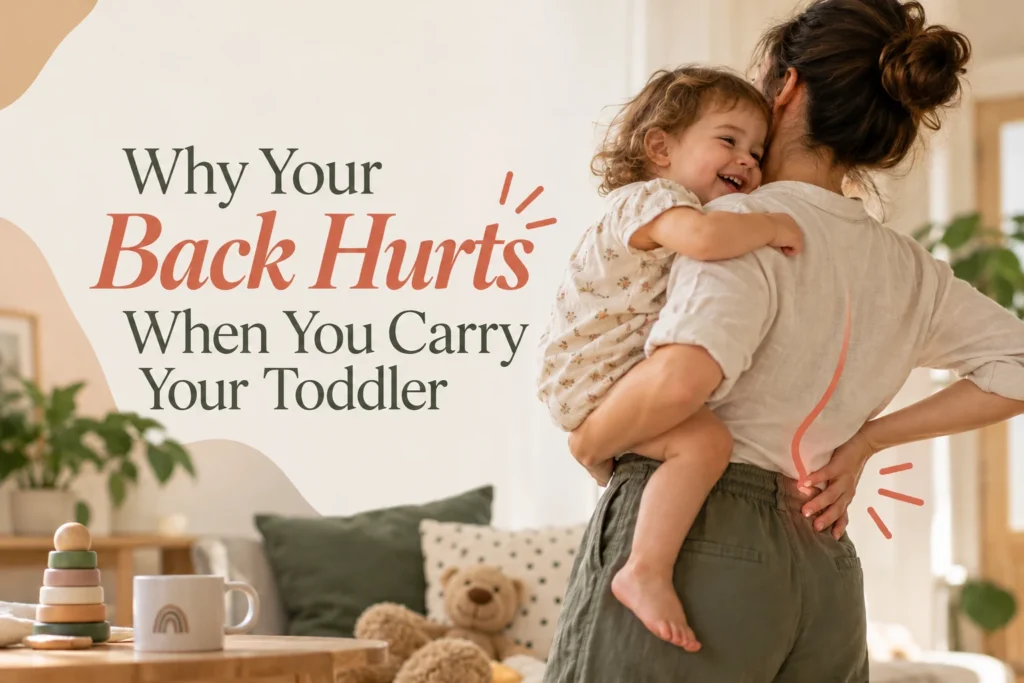
Why your back hurts when you carry your toddler
For every mother on the third landing with a sleeping child and a bag of vegetables. What is happening in your body, how to tell if your carrier is making it worse, and what helps.
It is 6:40 p.m. and the lift is out again.
You are on the third landing with a bag of sabzi in one hand and your two-year-old on your hip. Her head is heavy on your shoulder. She fell asleep somewhere between the school gate and the stairs, and you did not have the heart to wake her.
Your lower back has been sending you a message since the first floor. You ignore it, the way you ignore it most evenings. You move her to the other hip, tilt a little to one side, and keep climbing.
Upstairs, the cooker is waiting. So is dinner. The moment you try to put her down she stirs and clings, so you do not. You chop with one hand and sway with the other, bent slightly sideways, the way you have quietly learned to stand.
Later, lying flat, you press a fist into the ache above your hip and think: this is just what mothers do. A friend laughed about it once. Someone at home said you carry her too much.
Here is what we would like you to hear. Being tired is part of this. Being in pain every evening does not have to be. How much your back hurts depends a lot on where the weight sits, and very little on how strong or careful you are.
That is what the rest of this post is about: why carrying a toddler hurts, how to tell when your carrier is making it worse, and what to change.
Your back hurts because a toddler's weight usually sits far from your body and on one side, so your lower back and shoulders do work that your hips and legs are better built for. Carry her close, high and facing you, with a wide base under your hips, and change sides through the day.
A toddler is a different load from the baby you started with
Between her first and third birthdays, the median child on the WHO growth chart goes from about 9 to 10 kg to about 14 kg. That is one extra 5 kg bag of atta, and unlike atta, it wriggles, climbs and leans out to look at a pigeon.
From first to third birthday, a child gains about 5 kg
Median weight for age in kilograms, WHO Child Growth Standards. Hover or tap the chart for each age.
| Age | Boys, median kg | Girls, median kg |
|---|
Source: WHO weight-for-age tables, z-score medians, boys and girls, birth to 5 years. Individual children vary widely around the median, and your child's own curve matters more than any average.
Weight is only part of it. A load that shifts asks more of your muscles than a load that stays still, and a toddler does not stay still.
The lean you cannot stop doing
Pick a toddler up with no carrier and your body invents a seat. You push one hip out, tilt your trunk and let her sit on the shelf you have made. The International Hip Dysplasia Institute describes the same habit in its babywearing statement: when a mother carries a child on her side without help, she shifts her waist and trunk to give the child more sitting support.
It works for a few minutes. Over a long evening it asks the same few muscles to hold the same lopsided posture, again and again.
Where does the weight rest?
A schematic, not to scale. Left: weight held out to one side pulls the trunk into a lean. Right: a wide base under the hips lets the weight pass down through both legs.
Distance matters as much as side. The IHDI notes that a child held facing you sits closer to your centre of gravity and is easier to carry than one facing away. Orlando Health's paediatric guidance makes the same point: keep the weight close and the load feels lighter.
Five signs it is the carrier, not you
Some aching after a long day is common. These patterns suggest the carrier, or the way it is set up, is adding to it.
- The ache sits on one side. If it is always the same side, one hip is doing all of the carrying.
- Your shoulders and neck tire before your hips do. The straps are holding weight that a belt or base should be holding.
- You lean back or sideways to balance her. The weight is sitting too far out in front of you.
- You keep adjusting. A carrier that slides down or forward is telling you the fit is not working.
- She hangs low and far from your body. Aim for high and close. If you can kiss the top of her head, the height is close to right.
Sharp pain, pain that travels down a leg, numbness, or an ache that does not ease with rest deserves a doctor or physiotherapist. A different carrier will not replace that.
How to carry a toddler with less strain
- Set the base first. Put the belt or waist base on before she goes in, snug over your hips.
- Lift with your knees. Bend, bring her in close to your chest, and keep her facing you while you settle her.
- Bring her high and close. Her weight should sit near your own centre. If it hangs out and low, adjust before you walk.
- Support the whole thigh. The IHDI recommends carriers that support the thigh to the knee, with the legs spread and the knees slightly above her bottom.
- Stand tall, then swap sides. Keep your shoulders soft and your ribs over your hips. Change sides through the day so one hip does not take every trip.
- Let her walk the easy part. A toddler who walks the first stretch of the market is usually glad to be lifted for the last.
What to look for in a toddler carrier
- A wide, firm belt or base
- Moves weight from your shoulders and spine to your hips.
- A seat that supports thighs knee to knee
- Matches the hip position the IHDI recommends and stops her from dangling.
- A size made for her, not a newborn
- The IHDI advises matching the carrier to the size of the child so her hips can sit in a healthy position.
- Breathable natural cloth
- Indian afternoons are warm, and a carrier that traps heat ends up in a cupboard.
- Adjustments you can make alone
- You will hear "up, please" many times a day. The carrier has to work one-handed.
She will not always ask to be held. Until then, you deserve to hold her without paying for it every evening.
Questions mothers ask
Why does my back hurt when I carry my toddler?
Because the weight sits far from your body, usually on one side, for long stretches. Your lower back and shoulders take over work that your hips and legs are better built for. Carrying her close, high and supported at your hips spreads the load.
Is it bad to carry a toddler on one hip?
Short carries are fine. The strain comes from doing it for long periods, always on the same side. When you carry a child on your side without help, you shift your waist and trunk to give her a seat, as the International Hip Dysplasia Institute describes. Change sides often, and use a carrier with a wide base for longer carries.
How heavy is a 2-year-old?
The WHO median weight at 24 months is 12.2 kg for boys and 11.5 kg for girls. At three years it is 14.3 kg for boys and 13.9 kg for girls. Healthy children vary widely around these medians.
Is it too late to start carrying a 2-year-old?
No. The IHDI says hip dysplasia risk is greatest in the first few months of life, so at two the question is comfort and closeness rather than a missed window. What changes is her weight, so choose a carrier made for a toddler.
Does carrying a toddler harm her hips?
The IHDI considers periodic short-term use of a baby carrier unlikely to affect hip development. For long carries it advises a carrier that supports the thighs, lets the legs spread with the hips and knees bent, and is sized to the child. It does not recommend narrow-based carriers that leave the thigh unsupported for prolonged use. If you have any worry about her hips, ask her paediatrician.
When should I see a doctor about back pain from carrying?
See a doctor or physiotherapist if the pain is sharp, travels down a leg, comes with numbness or weakness, or does not ease with rest. A better carrier can reduce strain from carrying. It does not replace a medical opinion.
Sources
- International Hip Dysplasia Institute, Baby Wearing
- International Hip Dysplasia Institute, Baby Carriers & Other Equipment
- Orlando Health, Is Babywearing Hurting My Child's Hips? (June 2019)
- WHO Child Growth Standards, weight-for-age, boys, birth to 5 years
- WHO Child Growth Standards, weight-for-age, girls, birth to 5 years
Published 12 October 2026. This article is general information and does not replace advice from your doctor, physiotherapist or paediatrician.
The question we design around: where does the weight rest?
It is the first question we ask under biomechanics, one of the six disciplines in our design framework. The Nest Hip Seat, our design for the up and down years, starts from it. We are developing it in handwoven Chanderi cotton, with Indian body measurements guiding the sizing.
The Hip Seat is still in development. Final specifications, sizing and age guidance, along with test results and certifications, will be shared when they are confirmed. A careful launch is planned for 2028.